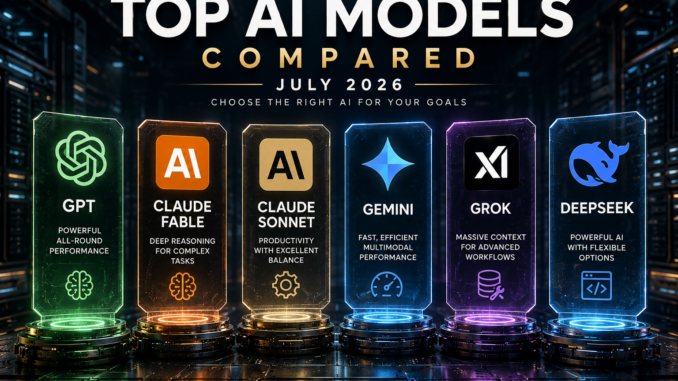
The AI model race has become harder to follow—and less useful to follow blindly.
New models now appear every few weeks. Each launch arrives with benchmark charts, claims of frontier intelligence and demonstrations designed to make the previous generation look obsolete.
For most professionals, entrepreneurs and creators, however, the important question is not which model is technically number one.
It is which model produces the best result for the work you actually need to do.
As of 26 July 2026, the strongest general-purpose options include OpenAI’s GPT-5.6 family, Anthropic’s Claude Fable 5 and Sonnet 5, Google’s Gemini models, xAI’s Grok 4.3 and DeepSeek V4 Preview. Each is capable, but they are optimised for different combinations of reasoning, speed, autonomy, context, cost and accessibility.
There is no universal winner. There is a better model for each job.
The leading models at a glance
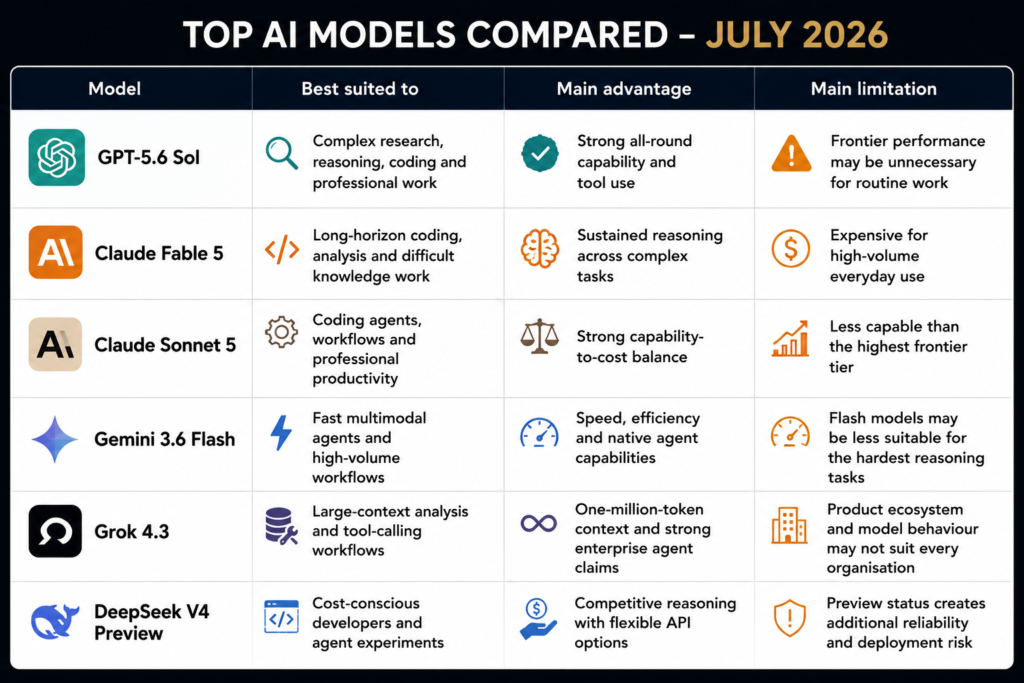
The table is a starting point, not a final verdict. Model quality increasingly depends on the surrounding product: its search tools, memory, connectors, coding environment, privacy controls and ability to take action.
GPT-5.6 Sol: the strongest general-purpose operator
OpenAI launched the GPT-5.6 family on 9 July 2026, with Sol as its flagship, Terra as the balanced everyday option and Luna as the fastest, lowest-cost member. OpenAI positions Sol for demanding work across coding, research, science, cybersecurity, computer use and design.
The practical strength of GPT-5.6 Sol is breadth.
It is designed for situations where a task crosses several disciplines: researching a market, analysing documents, building a financial model, creating a presentation, writing code and reviewing the final output. This makes it especially useful for professionals who want one AI workspace rather than a collection of narrow tools.
Sol is likely to be the most useful choice when the cost of a weak answer is higher than the cost of additional computation. Examples include strategic analysis, complex client work, difficult debugging and multi-stage research.
For ordinary emails, summaries or first drafts, however, Sol may be excessive. GPT-5.6 Terra or a faster model can often provide enough quality with lower cost and latency.
Best for: complex, multidisciplinary work where reliability and depth matter more than speed.
Claude Fable 5: built for sustained difficult work
Anthropic describes Claude Fable 5 as its most capable generally available model, with particular strength in software engineering, professional knowledge work, vision and scientific research. The company says its advantage becomes more pronounced as tasks grow longer and more complex.
This distinction matters.
Many AI models perform impressively on a single prompt but become less reliable over a long project. They lose track of instructions, repeat work or make inconsistent decisions after multiple tool calls.
Fable 5 is positioned for tasks that may run for hours or days: navigating a large codebase, conducting extensive research, analysing a complicated set of documents or coordinating a multi-agent workflow.
Its API pricing—US$10 per million input tokens and US$50 per million output tokens—also signals that it is intended for high-value work rather than cheap bulk generation.
For a founder or professional, Fable 5 makes sense when the AI is replacing substantial expert labour. It makes less sense when it is producing hundreds of basic product descriptions or reformatting routine data.
Best for: difficult coding and knowledge projects that require sustained attention and judgment.
Claude Sonnet 5: the practical value choice
Claude Sonnet 5 may be more important to most users than Fable 5.
Released on 30 June 2026, Sonnet 5 is designed for agentic work: planning, using browsers and terminals, writing code and carrying out multi-step workflows. Anthropic says it approaches the performance of the larger Opus 4.8 model at lower cost.
Its introductory API pricing is US$2 per million input tokens and US$10 per million output tokens until 31 August 2026, rising to US$3 and US$15 respectively after that date.
That makes Sonnet 5 a strong candidate for production workflows. It may not win every benchmark, but it offers enough intelligence for coding, research and automation without requiring frontier-model pricing for every task.
For a solo operator building a publishing engine, internal research agent or customer-support workflow, this balance can matter more than having the absolute strongest model.
Best for: entrepreneurs and developers who need capable agents at a sustainable operating cost.
Gemini 3.6 Flash: speed and scale for agentic workflows
Google introduced Gemini 3.6 Flash on 21 July 2026 as a workhorse model for coding, knowledge work and multimodal agents. Google says it improves token efficiency over Gemini 3.5 Flash while reducing the cost per output token.
Gemini’s advantage is not simply intelligence. It is the combination of speed, multimodal capability and integration with Google’s wider ecosystem.
Gemini 3.5 Flash already included native computer-use capabilities, allowing developers to build agents that can interact with browser, mobile and desktop interfaces. Gemini 3.6 Flash pushes the workhorse model further towards scalable, production-grade agents.
This makes it attractive for high-volume applications such as document processing, customer operations, research pipelines, multimedia analysis and workflows connected to Google services.
The trade-off is that a fast workhorse model should not automatically be treated as the best model for every high-stakes reasoning task. A useful system may route routine work to Flash and escalate only the hardest decisions to a frontier model.
Best for: fast, multimodal and high-volume agent workflows.
Grok 4.3: long context and connected intelligence
xAI says Grok 4.3 offers a one-million-token context window, configurable reasoning effort and strong performance in tool-calling and complex document analysis. The model became generally available through Amazon Bedrock in June 2026.
A large context window can be valuable when analysing extensive source material: corporate filings, research archives, legal documents, code repositories or years of internal records.
But context size is not the same as comprehension.
A model may accept a million tokens without using every part of them equally well. Users should still test whether it can retrieve the correct facts, follow conflicting instructions and maintain consistency across the entire dataset.
Grok’s broader product strength also comes from its connection with current information and the xAI ecosystem. That can be useful for market monitoring, news-sensitive research and scheduled intelligence workflows.
Organisations should nevertheless examine privacy, governance and output style rather than selecting it solely because it can ingest more material.
Best for: large-document analysis, connected research and tool-calling applications.
DeepSeek V4 Preview: capability with a lower-cost philosophy
DeepSeek released V4 Preview in April 2026 with two API options: deepseek-v4-pro and deepseek-v4-flash. The company positions the release around improved reasoning and agent capabilities, while describing it clearly as a preview.
DeepSeek remains relevant because it pressures the market on cost and accessibility. It gives developers another route to capable reasoning without depending entirely on the largest US model providers.
However, preview models require additional caution.
Before using DeepSeek V4 in an important workflow, developers should test output stability, data handling, uptime, tool use and migration risk. DeepSeek retired its earlier deepseek-chat and deepseek-reasoner API names on 24 July 2026, illustrating how quickly integrations may need to change.
Best for: cost-sensitive experimentation and developers willing to manage greater platform risk.
Which AI model should you choose?
The most practical selection framework is based on the economic value of the task.
Use a frontier model when an error is costly, the work requires deep judgment or the task spans many steps. Use a balanced model for everyday professional output. Use a fast model for high-volume, repetitive operations.
A sensible starting allocation might look like this:
- Complex strategy, research or difficult coding: GPT-5.6 Sol or Claude Fable 5.
- Everyday coding and agent workflows: Claude Sonnet 5 or GPT-5.6 Terra.
- Fast multimodal processing and automation at scale: Gemini 3.6 Flash.
- Very large document sets or connected research: Grok 4.3.
- Cost-sensitive experimentation: DeepSeek V4 Preview.
The next step is not to subscribe to every platform. It is to build a small test set based on your actual work.
Choose five to ten representative tasks. Give each model the same source material, instructions and success criteria. Compare the results for accuracy, time saved, revision required, cost and ease of integration.
The winning model is the one that creates the most usable value after human review—not the one with the most impressive launch presentation.
The real advantage is the system around the model
AI models are becoming more capable, but model selection is only one part of building leverage.
A strong model inside a weak workflow still produces inconsistent results. A slightly less capable model connected to clear instructions, trusted data, review checkpoints and repeatable processes may create far more value.
The durable advantage therefore comes from building a model-independent system:
- Define the outcome clearly.
- Supply reliable context and source material.
- Route tasks to the appropriate level of intelligence.
- Keep humans responsible for judgment and verification.
- Measure output quality, cost and time saved.
- Retain the ability to change providers as models improve.
The best AI model in July 2026 may not remain the best model in December.
The more valuable asset is the operating system that lets you test, replace and combine models without rebuilding the way you work.
Takeaway: Do not build your AI strategy around loyalty to one model. Build a repeatable system that uses the right level of intelligence for each task—and converts that intelligence into saved time, better decisions and assets that continue creating value.